Quick answer
How Beja eats
Beja is a working Alentejo capital, not a resort town, and it eats like one. Lunch is the serious meal: workday dining rooms fill from 12:30, portions assume you have been in a field all morning, and the kitchen is built on the regional canon: bread-based migas and açorda, black pork, lamb slow-cooked into ensopado, gaspacho in summer, and local wine that costs less than you expect and is better than it needs to be.
That has two practical consequences. First: aim for lunch by 13:00 or book, because the good rooms are small and locals get there first. Second: check the closing day. Most houses here close one or two days a week, often Sunday evening and Monday, and August brings holiday closures nobody announces very loudly.
Adega Típica 25 de Abril
The classic. It occupies an old wine cellar and still looks like one: the decoration has stayed where it was, the menu reads like a syllabus of Baixo Alentejo cooking, and the wine list is local almost out of principle. Order whatever is written on the board, and if lamb is on it, stop reading the board.
- Best forA first Alentejo lunch, lamb when it is on the board
- Price€20 to €40 a head
- Phone+351 284 325 960
- WhereHistoric centre, a few minutes from Praça da República
D. Dinis
A few steps from the castle keep, which makes it the natural landing after a morning in the upper town. The house trades in charcoal: black pork, beef and lamb over the grill, regional plates around them, and an Alentejo wine list that takes itself seriously. It is where our morning walking route deliberately ends.
- Best forCharcoal-grilled black pork after the castle climb
- Price€20 to €40 a head
- Phone+351 965 337 578
- WhereA few steps below the castle keep
O Alentejano
On the Largo dos Duques de Beja, this is the house that cooks the region the way the region cooks at home: migas, slow stews, game in season, in portions that assume the table is sharing. The room fills with locals before most visitors have started thinking about lunch, and nothing in it is performing for anyone, which, in this town, is the highest compliment on offer. Book or come early.
- Best forMigas, slow stews, sharing portions
- Price€20 to €40 a head
- Phone+351 284 323 849
- WhereLargo dos Duques de Beja
Luiz da Rocha
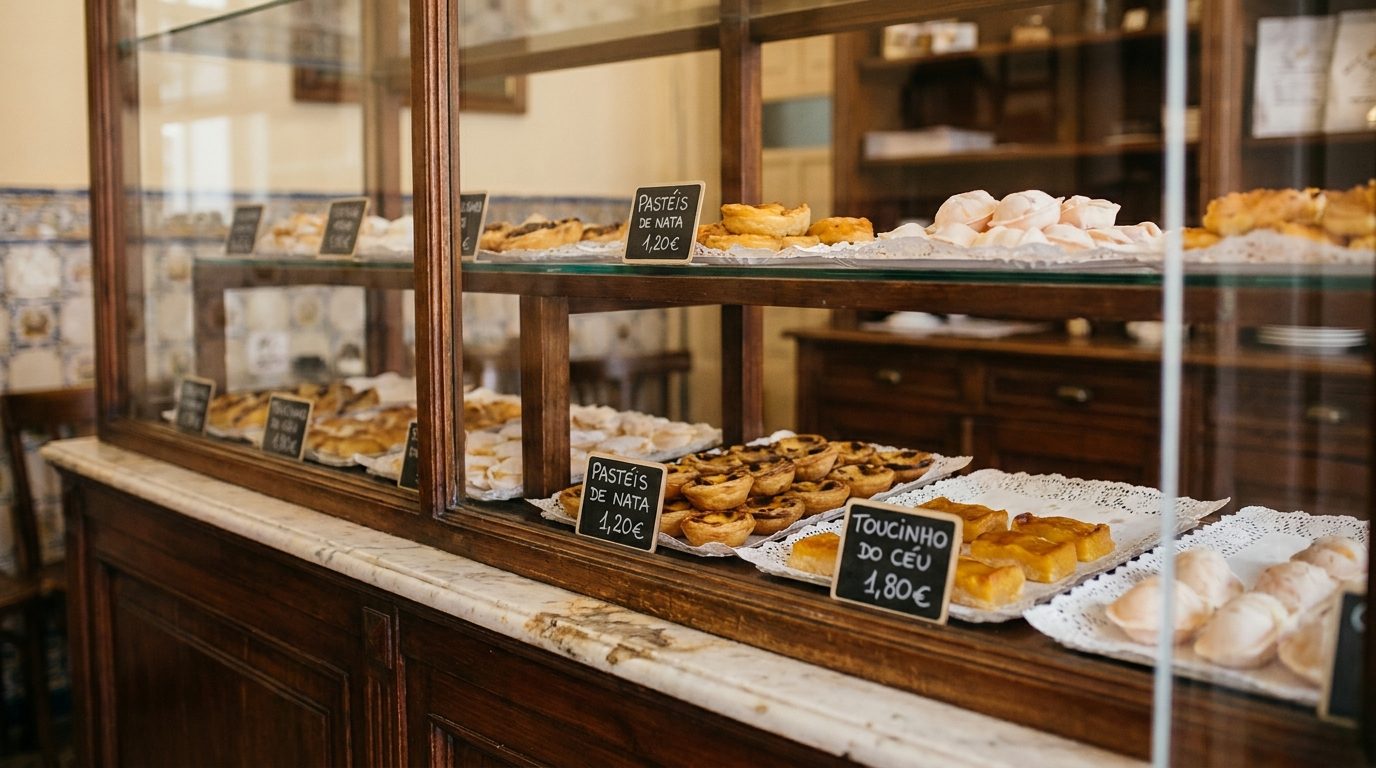
Open since 1893 and run by a workers' cooperative since 1976, this is Beja's historic cafe and the keeper of its sweet tradition. The house speciality is the porquinho doce: a little pig of almond, egg, sugar and gila, a recipe born in the Convento da Conceição and given its fixed shape here. Come for the mid-morning coffee, leave with a box.
- Best forMid-morning coffee and the porquinho doce
- PriceCoffee and a sweet, small change
- Since1893
- WhereRua Capitão João Francisco de Sousa, the main pedestrian street
Casa de Chá Maltesinhas
The calmer counterpoint: a tea house given over to convent sweets, made properly. If Luiz da Rocha is the counter you stand at, Maltesinhas is the table you sit at. Good in the late afternoon, when the town slows down and the sugar is defensible.
- Best forConvent sweets at a table, late afternoon
- PriceTea and a sweet, small change
- WhereHistoric centre, a short walk from the square